
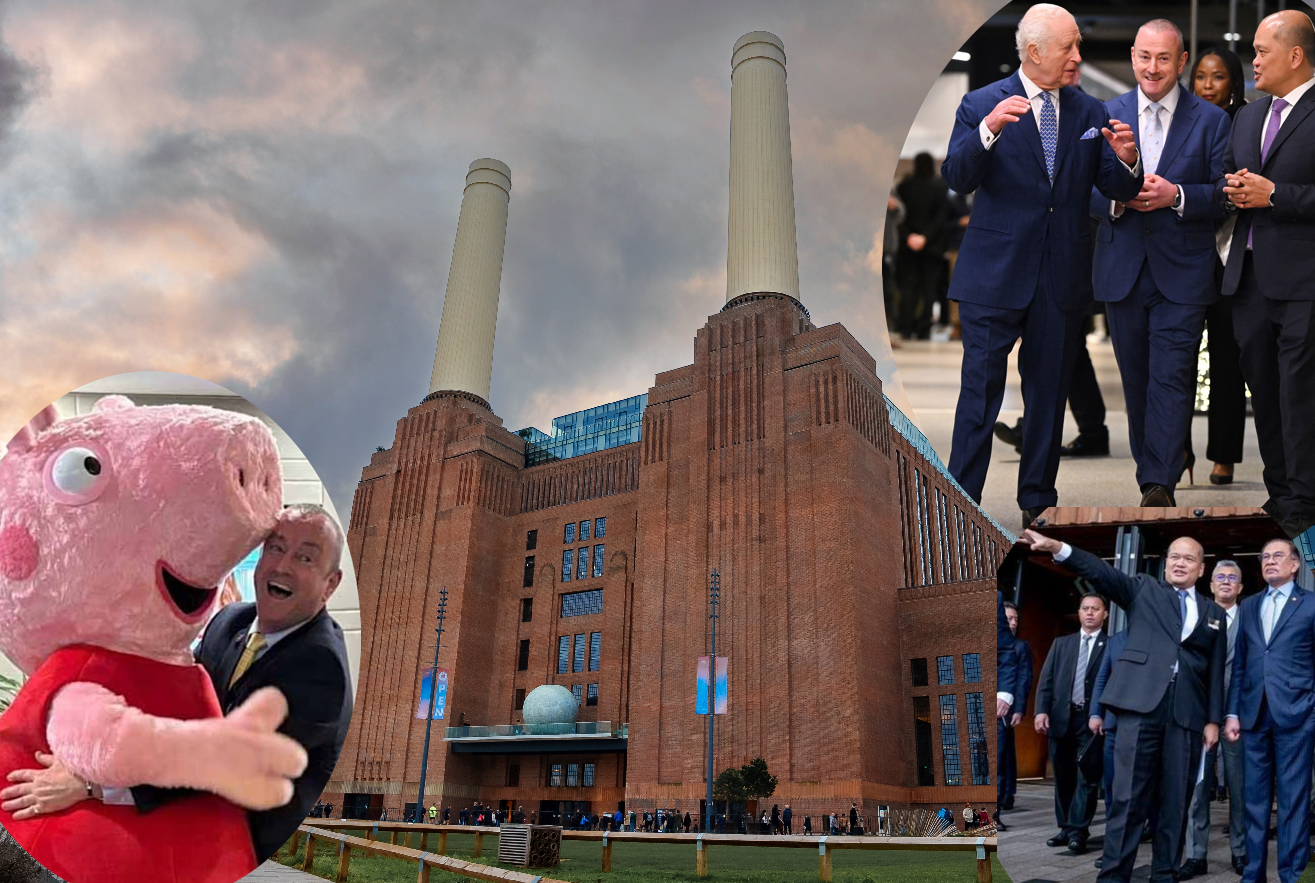
It is not often the CEO of a major public owned company acts as a whistleblower, alleging the massaging of accounts to the tune of hundreds of millions of pounds (RM1.7bn).
Don O’Sullivan had been offered the chance to quietly walk away instead with a very nice settlement comprising 6 months payment of his half million pound annual salary. Why did he stand his ground?
O’Sullivan’s complexion changes colour “I had to do the right thing”, he says, “These were public companies with ordinary shareholders and pension funds which had invested huge sums and were being misled”.
These stakeholders had been led to believe by the company accounts that they were investing in a viable concern when the reality was that the Battersea Power Station project was losing money, which needed tackling head on, he goes on to explain. In other words, once again the Malaysian public and Malaysian government run funds are allegedly haemorrhaging cash, thanks to dubious investments backed by former prime minister Najib Razak.
Najib’s Signature White Elephant Project
The 42 acre Battersea Power Station site had long been considered a notorious White Elephant project, requiring huge investments but boasting a potentially prestige outcome with eventual profits. It had changed hands a number of times as developers pulled out before a Malaysian consortium of largely public owned institutions took over in 2012, making a massive and welcome investment in the UK capital’s most troublesome development.
The £400m purchase was through a consortium consisting of SP Setia (40%) and Sime Darby Properties (40%). Both companies are listed on the KL stock exchange and are largely owned by the Malaysian government controlled investment fund PNB and the government pension fund EPF. The remaining 20% of the company Battersea Power Station Development Company (BPSDC) is directly owned by EPF (Malaysia’s public workers pension fund).
BPSDC itself only has a net value of £1.7 million in its published accounts as it is structured as a subsidiary of a conveniently opaque offshore holding company, BPS Holdings, a Jersey-registered entity owned by the same parties.
By 2018 it had become apparent, however, that the Malaysian consortium was running out of cash and into trouble. In January that year the two public Malaysian funds which already owned the lion’s share of the consortium plunged a staggering £1.6 billion into effectively buying out part of their own project – it was the biggest UK property sale on record and the money invested was earmarked to cover the remaining exponential development costs needed to raise profits.
At the time and over the ensuing years Sarawak Report predicted a possible disaster waiting to happen. The deal held dangerous signs of being a vanity project by the man at the top in Malaysia whose intervention was clearly needed to sign it off, namely the Minister of Finance who ultimately controlled the two funds and also happened to be the Prime Minister, Najib Razak.
Najib had been ingratiated by the UK prime minister, David Cameron, the then London mayor Boris Johnson, and the self-proclaimed dealmaker Lord Jonathan Marland (the UK prime minister’s then trade envoy), who all turned up for photo-ops with the Malaysian PM as he turned the earth on the site in 2012.
Marland called the deal his proudest achievement and would later take a directorship at the Eco-world group run by the former CEO of SP Setia which was developing adjacent sites. The businessman lord gravitated to the role of trusted PR advisor to Najib, burnishing his image after the 1MDB scandal hit and helping in election campaign work. Marland’s Commonwealth branded business venture, the so-called Commonwealth Enterprise and Investment Council, counted Malaysia as a ‘strategic partner’.
Another official caught up in smoothing the deal was the Mayor’s key officer Edward Lister (former chair of the local Wandsworth Council) who was later forced to resign a directorship he also took at Eco World following exposure by Sarawak Report. He sought to return to the role during his period working as a special advisor to Johnson whilst prime minister, but was ruled against by the Advisory Committee on Business Appointments which judged he should not do so until 6 months after leaving his post (which he did on the day the 6 months expired).
In January 2018 with a crisis election looming in the wake of the 1MDB scandal, the last thing Najib had needed was the collapse of the project he had already invested Malaysia’s public and pension money into, along with his own credibility to boot. Hence the massive £1.6 bn shot in the arm for the Battersea development which has become a great success for Londoners in terms of the core building having now been transformed into a vibrant and popular shopping, commercial and residential property area with almost half the 42 acres still remaining to be developed.
However, Najib lost the election and the massive funding duly turned out to be still inadequate to cover the exponential costs of transforming an iconic but troublesome landmark structure. Reports make clear that in an adverse post-Covid economy the costs of the development have spiralled with specialists highlighting the difficulties in making commercial returns on large buildings in the present market.
‘Clean Up’
Don O’Sullivan took on the job of CEO of Battersea Power Station Development Company (BPSDC) in June 2024 after a decades long career at the high profile private developer Galliard Homes, where he was Chief Executive for five years. He replaced a predecessor who had been in the job at Battersea since 2008 navigating over a decade of re-financing crises and new ownerships.
“At Galliard I was used to rigorous corporate governance as we conducted numerous joint ventures which demand the highest standards of compliance and due diligence”, he says “I assumed in joining a public owned company that the corporate governance would be at least equal to that standard, with additional obligations because of public ownership”. He acknowledges a level of naivety having now scrutinised Malaysia’s record on joint ventures and public investments, particularly under Najib.
The two Chief Executives of the key shareholder companies SP Setia and Sime Darby Properties were both on the board of the Battersea development company (as was he) and also its parent Battersea Project holding company BPS. A newly appointed Chairman of the Board of the Jersey holding company, Shahril Ridza Ridzuan, had close ties to PNB.
In September, O’Sullivan was tasked by a meeting of the development company board to find a way to recover the £1.4 billion in equity so far invested in the business and later, as part of the exercise, to draw up a ‘Strategy Paper’ for the future phases of the project where there were still 19 remaining acres of purchased land to build on.
As a result, he did a deep dive review of the state of the development and its accounts. He claims the plan of approach he presented to the two CEO’s of SP Setia and Sime Darby Properties was considerably more detailed than previous overviews as commented on by the latter, Azmir Merican. However, his research did not result in a happy outcome.
The first thing O’Sullivan says he noticed was that two separate market valuations commissioned by BPSHC with regard to the five remaining undeveloped phases on the site (bought for £150m in 2012) only calculated their current worth at a total of £647 million. Yet the company accounts had them valued at £965 million, a whopping £318M more than the independent valuations.
BPS have subsequently argued they use a different method of valuation, saying this higher figure was representative of the amount of investment that had been injected indirectly into the sites on top of the original land purchase cost, for example simply managing the ownership in advance of any construction or investing in relevant infrastructure (such as the Northern Line); value that could expect to be realised once the projects were for sale. Except, says O’Sullivan, the evidence shows that level of investment (£815 million) had not been made on those remaining phases.
“As an example of the misreporting”, he explains, “for Phase 3C in the Statutory Accounts for y/e 31 December 2023 they showed £220M of ‘inventories’ – this term means that the value of completed (and/or part built) apartments at that time was £220M. But Phase 3C did not even get planning permission until April 2025 and as at today’s date no construction has yet been started on Phase 3C, there are even today no completed or part built apartments on Phase 3C.”
For this reason, he points out, the independent valuation provided by Jones Lang LaSalle for Phase 3C at that time only valued 3C at £100M (£120 million shortfall on this phase alone).
It got worse: for Phase 7, O’Sullivan notes, there was no independent valuation – because it was no longer owned by Battersea Power Station, having been sold in 2014. Yet in Q4 2024 it remained on the BPS books at an asset value of £53M, up from the £44M asset value in those same statutory accounts from 31 December 2023.
O’Sullivan concluded from the accounts, backed he says by confirmation he received from a company financial executive (who he says admitted he had been “uncomfortable” and “pressured” to put through the figures) that over successive years BPHoldCo had been shunting running costs of the company into the alleged investment costs associated with developing those future sites (a so-called capitalisation of costs).
A minimum £318 had thus been repackaged, concluded O’Sullivan, as if they were costs invested in building on sites that had not yet started to be developed, with the effect of disguising heavy ongoing losses on the existing built project which, if known about, could have severely jeopardised the value and viability of the company (and incidentally, he claims, the bonus arrangements for top execs).
PWC London, on behalf of PWC Malaysia, had nonetheless signed off on these ‘massaged’ accounts without any reference to the independent valuations, neither was there evidence the company had interrogated the detailed figures which conflicted with the statutory accounts, says O’Sullivan.
O’Sullivan says he was very worried by the disparities and misreporting and drew up a presentation stating the stark financial situation. As he would report to the UK Employment Tribunal last month this was “made in the public interest” because “the BPS development was a public project, ultimately owned and run for the benefit of stakeholders in pension funds and public companies in Malaysia”.
However, when he presented his findings in good faith at meetings in early November to managers and then in more detail to the CEO’s of Sime Darby Properties and SP Setia, Azmir Merican and Choong Kai Wai, he says he was shocked by the angry and critical response. Rather than address his concerns, he says, they attacked side issues and an alleged lack of ‘strategic vision’ on his part.
At that point, he claims, he realised he was not telling these executives anything they did not already know about the state of the accounts. At a follow-up meeting one accused him of “being in the 80s” according to his complaint.
The company have presented a different version of events, saying the criticism owed not to O’Sullivan’s questioning of the finances but rather because his work so far on the proposed Strategy Paper “was a disaster” and not what the company had expected (having taken just over a month to produce rather than a far shorter expected time): his presentation “did not present any clear strategic direction for the business and the Claimant’s performance in this [Nov 8] meeting was embarrassingly poor”.
Lash Back
O’Sullivan dates any problems he had with the company from that meeting, saying he had received zero negative feedback before that point but that going forward he experienced immediate accusations, first over performance and an alleged poor relationship with colleagues and then of misconduct.
The day following the third discussion, 14th November 2024, BPSDC’s Human Resources Director, Donna Lythaby, was informed by the two Malaysian directors that O’Sullivan’s plans to hire new staff should be frozen. At a Teams meeting about this in the afternoon Azmir Merican allegedly accused O’Sullivan of ‘lying’ and not being up to the job. A deputy to Azmir Merican then contacted Don O’Sullivan to say that he would be flying over from Malaysia to discuss matters in ten days time.
The tension could not have arisen at a more delicate time given O’Sullivan had been assigned a leading and responsible role in the upcoming royal visit to the newly completed power station core shopping complex by King Charles on December 12th. He would continue to perform those duties.
Yet, at their meeting in the run up to that event, towards the end of November, Azmir Merican’s envoy told him that the two CEOs of SP Setia and Sime Darby Propertis now considered they ‘had a problem’ with their relationship with O’Sullivan. Likewise, they alleged O’Sullivan had ‘problems’ with his senior team(O’Sullivan says he enquired later of his senior staff who told him they had no issues).
The envoy said that if O’Sullivan tried speaking with Choong and Azmir it would make it worse. In their joint tribunal statement the CEOs claim they had by then identified him as “unable .. to demonstrate any real insight into what was required of him as CEO” and as “losing the confidence of the dressing room” with staff. It is admitted management had provided no specifics to back such concerns at the time.
The two CEOs officially recommended O’Sullivan be sacked on 28th November, just after that meeting, and claim that before this date O’Sullivan had not raised formal whistleblowing issues. A letter drafted by managers acknowledged the “timing is deeply unfortunate” but insisted the disciplinary complaints were “not linked” to him raising concerns about the accounts (it was eventually decided not to send this letter).
To the contrary, the company alleges that it was only after O’Sullivan learned of plans to remove him that he cooked up his whistleblowing complaint based on an “inadequate understanding of the financials of the business“. His only motive, say his former Malaysian employers was “to improve his personal position when facing dismissal for poor performance”: it was not a matter of public interest.
Whistleblowing Complaint or False Allegation?
Clearly under attack, O’Sullivan decided to inform the new Chairman of the Jersey holding company (where the accounts were lodged away from public scrutiny), Shahril Ridza Ridzuan, emailing him on December 2nd. O’Sullivan’s email began “I am acutely aware of the seriousness of this message, and I am equally conscious of obligations and fiduciary duties I hold as a director of BPS entities”, before he confided his “profound and serious concerns regarding financial reporting issues at BPS”.
He forwarded a copy of that email to the Head of Human Resources, Donna Lythaby, who responded by acknowledging a whistleblower complaint had been made and sending him a copy of the company policy on whistleblowing.
Copies of communications with O’Sullivan indicate that Shahril was responsive and showed concern on behalf of the main shareholders at PNB that these issues should be addressed. He said he would seek to work behind the scenes to help the CEO deal with problems in the accounts.
After a discussion on the morning of the royal visit, which he had arrived from KL to attend, Shahril agreed to raise the matters at a BPS Holding Company board meeting just before Christmas on December 16th.
Sarawak Report has obtained a recording of the relevant segment of the meeting and a transcript.
This evidence shows that Ridzuan raised O’Sullivan’s concerns as a genuine problem acknowledging operating losses had been presented as investment costs (‘capitalisation of expenditure/sunk costs’) in the future sites. He told directors “the biggest structural problem really is your inflated sunk costs, what are you going to do with that? Because you are going to get hit by that at some point”.
Likewise, the two company CEOs, Azmir Merican and Choong Kai Wai, who had responded so angrily to O’Sullivan’s earlier warnings in November, did not appear to deny the allegation they just questioned how best to “clean up” the accounts.
“We need a tactical plan for when is the right time when we clean this up a little bit, whether it is one time or two time, we have to discuss bit maybe in strategy”, Sime Darby Properties CEO, Azmir Merican, replied.
The Chairman pushed back to reiterate “the two fundamental problems we have here, which are essentially the debt and your overinflated carrying costs sunk costs… you really need to look at this right, the first step to me is to stop capitalisation, because you are just prolonging the problem, you are not solving it.”
The CFO of the BPS Development Company chipped in “If you look at it, the sunk costs is substantially all the operating costs have been capitalised, from day one. So if you didn’t capitalise from day one then we won’t be having this conversation!” (A seeming admission the true picture on the balance sheet was deliberately being hidden as investment costs in future income generating projects).
SP Setia CEO, Choong Kai Wai had his own solution “In 2027, if all goes well in asset management, we have got a £200M upside”, to which Sime Darby Properties CEO, Azmir Merican, added “We could take a hit then, that’s the thinking”.
(See Excerpt Below)
Transcript quotes from Battersea Project Holding Company Limited (‘BPS HoldCo’) Board Meeting – 16th December 2024
TSS Tan Sri Shahril Ridza Ridzuan Chairman of BPS HoldCo
TSJ Tan Sri Jaganath Sabapathy Director of Sime Darby & BPS HoldCo, DA Dato Azmir Merican CEO of Sime Darby & Director of BPS HoldCo
DC Datuk Choong Kai Wai CEO of SP Setia & Director of BPS HoldCo
CSS Chee Seng Siew CFO of BPS Dev Co Ltd
TSS Coming back to my earlier question right, the biggest structural problem really is your inflated sunk costs, what are you going to do with that? Because you are going to get hit by that at some point?
TSS If you look at your budget right, there are actually line items for corporate costs, which are capitalised through, my section on that is we should really stop that.
CSS We did talk about this previously, we did say should we stop at the end of 2025?
DA We did debate this remember.
TSJ Ideally we would take it off you know
TSS Honestly right you’re just prolonging out your problems, and for the team you are adding costs to the phases that makes it impossible for them to do anything rational.
DA – “Chairman, the logic, the rationale, we think about logically we need to do the write off, because we are writing this further, the idea was ‘ok, we will reduce losses for each year, at some point maybe 2026 or 2027 it has to be taken down. So maybe that was the thinking before, you’re right we need a tactical plan for when is the right time when we clean this up a little bit, whether it is one time or two time, we have to discuss bit maybe in strategy.
TSS The draft strategy doesn’t address the two fundamental problems we have here, which are essentially the debt and your overinflated carrying costs sunk costs, as long as you don’t do that it is very hard for the company to move forward, for the shareholders to think rationally about cash recovery. Can I suggest that the respective CFO’s, you really need to look at this right, the first step to me is to stop capitalisation, because you are just prolonging the problem, you are not solving it.
CSS We need to do this in tandem, I mean ‘audit aside’ we need to make sure that the messaging isright because we go on the basis to try not to have further impairments in this year. So that exercise that you want to do, to go through and try to identify can only be carried out in 2025. Otherwise…..
DA Chairman my point is whether you straddle the hit, or you take a one-time hit, we need to, the two PLC’s need to have an idea what is really workable”
DC In 2027, if all goes well in asset management, we have got a £200M upside
DA We could take a hit then, that’s the thinking
TSS Can we not, at least do the work of identifying of what is actually the right carrying costs, so we need to know the size of the problem first right, and then we can identify how we are going to take that hit. Do we take it all in one go? Do we basically spread it out? To basically make sure that we send the right message to the market. We need to identify what is the size of the problem first. Which I think right now we don’t really know
CSS If you look at it, the sunk costs is substantially all the operating costs have been capitalised, from day one. So if you didn’t capitalise from day one then we won’t be having this conversation!
TSJ Phase 1 you wouldn’t have made so much money, and phase 2 you would have made less money
DA That is the reality
TSJ All of this are the sins of the past.
TSS There is at least £200M of opex (operating expenses)
DA I think to come to that, do we have a idea what is the right amount of carrying costs. So let’s say we take out 200 – will that be enough?
DA To be frank about it, in the scheme of things, if you’re going to take down two to three hundred million, if you capitalise £24M for two years might as well take it two years down the road or you know take it to the.. I don’t know I don’t know
TSS As a principle, if we are recognising we have this problem we should not be adding to the problem.
DA We need to think about it
TSS As a matter of principle for the budget today, we should not be capitalising opex. I know there will be a hit right, but you’re either taking a hit this year or next year
TSS I dropped a bombshell ..
This Teams recording in which directors and managers admitted the substance of O’Sullivan’s concerns, also that the problematic accounting had knowingly been practiced by the company, was swiftly removed after being uploaded says O’Sullivan. He later disclosed he had recorded the earlier November meetings where he had raised the same issues, which he believes counters those claims he had only raised the matter after the call for his dismissal.
Yet, if O’Sullivan came away from the meeting believing he now had the authority to take on the problem and sort it out, he soon learned he was mistaken. According to messages he exchanged with the Chairman during Shahril’s flight back to Malaysia the following day, the two CEO’s had just called him say things were ‘not working out’ and then suspended him:
O’Sullivan – “I guess you are mid flight enroute home to KL right now. Dato Azmir and Datuk Choong had a meeting with me from about 9.40 this morning. They’ve told me it hasn’t worked out and I should go home immediately and talk to them tomorrow morning they want to do a settlement exit agreement with me. There was a piece in the conversation about the sunk costs and their burden on future phases, there was a piece where I asked to bring [XXX] in and [XXX] gave a different answer on inventories than that he gave me last week. He is scared of losing his job. [Choong] and [Azmir] were very anxious about my challenges with the numbers. Can we speak at the soonest opportunity pls – I have left the office as instructed.”
Chairman – “Any specific reasons for it not working out? I guess they’ve been messaging this to you for a couple weeks now”
O’Sullivan – “No. Nothing specific. Generalities around it not working with the Team. But when asked they had no examples. The only examples I had been given previously by [Azmir’s envoy] was that my behaviour was unbecoming of the position of CEO of BPS – the specific examples
1. Learning names of people in junior roles on the estate – it was wrong that I spoke to cleaners, security guards and concierge member by their first names
2. The photograph on Linkedin of me hugging the Peppa Pig character when the new Peppa Pig shop opening at BPS was being marketed. No other examples. This all started from the issuing of the sunk costs table showing the £318M gap between the asset valuations on our books and the actual independent asset valuations. Choong said to me that ‘a little knowledge in accounting can be v dangerous thing’.”
Following the interchange O’Sullivan decided to fight, he says, and by this stage he was concerned that the misleading figures possibly owed to deliberate fraud. He therefore took the step of emailing the company’s legal department on December 21st under the subject heading False Accounting. The email explained: “At the Board Meeting on Monday 16th December, Tan Sri Shahril raised questions regarding historic sunk costs, from the discussion and statements that followed from Dato Azmir, Datuk Choong and Tan Sri Jagan and others, it was acknowledged that something in excess of £200M of costs have been transferred to future phases, to reduce the reporting of losses in earlier phases at BPS.”
Therefore, O’Sullivan requested the department to “appoint an independent law firm, appropriately experienced in matters relating to fraudulent accounting, to lead an investigation within BPSDC, including questioning staff and directors.” O’Sullivan ended with a reminder that “Deliberate miss reporting in statutory accounts is a serious criminal offence.”
The new CEO had thrown down the gauntlet; however he had done so via an internal process and, avowedly, in the interests of the company and its shareholders (not, he says, in response to complaints about his performance and the settlement offer to leave).
Yet, rather than BPSHold Co engaging in the process and collaborating to review O’Sullivan’s concerns, he says he found himself the target of an increasingly ruthless campaign to shut him up and get him out of the company, combined with an organised rebuttal of his whistleblowing complaint and criticism of the accounts.
Two days after the meeting, 18 December 2024, BPS emailed to inform O’Sullivan not to return to the office saying the company was prepared to offer him a without prejudice settlement deal including a six months severance offer tied to a 19 page non-disclosure agreement. There were no reasons given, save for the previous verbal allegations that there were ‘relationship problems’ with the Sime Darby Property and SP Setia CEOs and senior staff.
O’Sullivan this time called the Chairman stating “They just want to kick me out because they know I’m not going to sign their fake or any fake or false accounts for them. And I’m not going to lie for them”.
That interchange (also recorded) proves Shahril continued to be supportive, acknowledging problems with the accounts whilst warily indicating that the matter of intent was yet to be determined.
He told O’Sullivan he had relayed the concerns back to the major shareholders: “I think the PNB side is now fully aware of, what I’ve told them basically is that from my look at it, there is at least £220M of opex [operating expenses] costs right that have been put through to the capex [capital expenditure] which would need to be taken out in order for the project to move forward. So what they’ve asked me basically let’s verify the number which is what we said at the Board Meeting yesterday, right let’s verify the number then that’s actually then figure out what is that number that we’re talking about….. I mean the rest you can argue, whether it’s consultancy costs towards site wide or costs across the whole development right”.
O’Sullivan had pushed back. “Well they can’t argue the £53M on Phase 7”, to which the Chairman had reminded that £22 million could have been double counted before acknowledging “Yea so £220M plus £33M”.
Shahril continued “there was no dispute around the table [at the board meeting] when I said the sunk costs were too high for the project to proceed sensibly… I think [it’s] the first time it’s probably been properly acknowledged that the issue can’t carry on….I think I have support from [Sime Darby & SP Setia’s] CFOs and the other board members to push on this. I don’t think they’ve been comfortable for a while and just needed someone to step in who has an equally strong voice.”
Despite the nods from the top, the process to remove O’Sullivan continued. That same day, he says, BPS hired a hard-hitting US legal firm, Brown Rudnick, which would draw up a disciplinary case against him and oversee the process by which the company dismissed his whistleblowing complaint. This included the commissioning of a further accountancy report to rebut O’Sullivan’s figures, (which by then had been supported by forensic accountants, Moore Kingston Smith, who had concurred that a minimum of £318 million (RM1.7 bn) was misreported).
On 19th December O’Sullivan emailed Donna Lythaby saying he feared the company “may be about to assert entirely trumped-up charges because I raised a serious whistleblowing complaint”. It seems no coincidence that the day after that, 20th December, the aide to Azmir Merican also emailed Lythaby from KL requesting a copy of the company’s disciplinary policy.
The process was clearly extremely painful for Don O’Sullivan. Having initiated disciplinary proceedings without adequately explaining the nature of the complaints against him, BPS instructed him immediately before Christmas that he was suspended from work and should not return to the office. This was in response to his refusal to accept the settlement offer.
After several weeks with no feedback O’Sullivan was called to a ‘disciplinary investigation’ meeting conducted by a barrister, who he claims was also commissioned by Brown Rudnick, to judge the allegations against him. “The Barrister met me once, they did not provide me with any evidence of anything prior to, or during that investigation meeting. I offered witnesses to speak on my behalf, he refused to meet them or even make contact. A Brown Rudnick solicitor did the note taking with him for his interviews on the ‘investigation'”, complains O’Sullivan.
Accusations of ‘unbecoming behaviour’, he says were belatedly presented to his lawyers before a hearing where a senior executive read a pre-prepared statement and refused to ask or reply to questions. These accusations included O’Sullivan’s aforementioned willingness to engage with junior employees on a first name basis and hugging Pepper Pig.
Other charges, which he calls ‘trumped up’, were accusations he disparaged two female executives and had a “brusque and at times intemperate manner, veering into aggression if angry”. O’Sullivan maintains numerous female members of staff refused to endorse these claims when asked to do so and maintains there is no formal record of any complaint having been made against him prior to his November alert on the financial situation.
The company has since responded that “such complaints were made in an informal manner, and orally by telephone call, rather than formally and in writing”, however that this “did not detract from the fact that members of the Senior Leadership Team had been complaining about the Claimant, albeit in an informal manner”.
The KC’s report duly upheld that “a number of the allegations were substantiated, including some of very high seriousness”, based on the complaints provided by BPS. The KC also dismissed O’Sullivan’s claim to have suffered detriment as a result of whistleblowing, agreeing there was evidence “from October, and perhaps even earlier” of “serious dissatisfaction with his performance, his failure to foster effective working relationships with many members of his [team], and his failure to lead on and effectively deliver an acceptable strategic vision for the company”.
In fact, the KC concluded, it looked more likely “the matter was the other way around” and that O’Sullivan had cooked up the allegations after learning he would be fired in late November. In a statement to Sarawak Report by Brown Rudnick the company confirmed this charge saying BPSD “in its defence said O’Sullivan had realised he was likely to be fired and made a series of allegations to “improve his personal position when facing dismissal for poor performance”.
In May 2025 the outcome of the disciplinary process and ensuing appeal was a ruling that O’Sullivan be dismissed for ‘Gross Misconduct” without compensation.
A ‘Commercial Challenge’ not Dishonest Accounting
Meanwhile, O’Sullivan claims that the accountancy firm Evelyn & Partners, which was engaged to provide an independent assessment of the company figures in response to his whistleblowing complaint, had admitted they too were taking instructions from Brown Rudnick, the law firm hired to conduct the disciplinary process against him.
Sarawak Report approached Brown Rudnick for comment on its role. In response the law firm said “if the allegation is that the Evelyn Partners LLP and S&W and the KC’s investigations and reports were not independent … that would be a serious allegation impugning the honesty and integrity of external, independent professionals (who carried out their own independent investigations to determine the facts before providing their independent professional opinions and reports) and one which is contradicted by the contemporaneous documents”. The firm said it was unable to confirm whether the professionals received instructions through Brown Rudnick without understanding the scope of the allegation being made.
The accountancy report issued a robust and comprehensive denial that the concerns raised by O’Sullivan amounted to accounting irregularities. The same report disparaged the forensic accountants who had backed O’Sullivan’s conclusion that operating costs had been misplaced as capital investment (in order to disguise ongoing losses on the project) saying that, to the contrary, IFRS international reporting standards allow such displacements when developments are ongoing.
Specifically, the Evelyn & Partners rebuttal concludes that although 79% of the assigned capitalisation costs owed to staffing and related matters, with only the remaining attributable to actual infrastructure investments, such as the Northern Line (18%), these costs could be seen as having the ‘overarching objective of developing the site“, making it acceptable to categorise operational costs as capital costs.
Likewise, displacing costs to a site BPS didn’t own was acceptable since it had an option to buy the site and had set money aside in case it decided to take that up. “I can see no basis for suggesting that BPHCL’s decision to capitalise this expenditure amounted to “misreporting” the report stated.
To this BPS has added it its own claim that at the meetings where these issues were raised by O’Sullivan and acknowledged by executives “No one, including [O’Sullivan], made any reference to accounting or financial misreporting or to any potential illegality. Everyone, including [O’Sullivan], correctly identified this as a commercial challenge which required a commercial solution”.
Ultimately, since the company is based in Jersey, BPS has pointed out that it is conveniently not subject to UK rules in any case! The figures in question had been signed off by PWC London and O’Sullivan has told Sarawak Report the accounting firm recently opened its own investigation.
Employment Tribunal Complaint
If the Malaysian company thought disciplinary measures would get rid of the problematic CEO it had misjudged. Don O’Sullivan has brought a whistleblower’s complaint to the UK Employment Tribunal which has already gained widespread media attention in the UK reflecting on the possible concerns regarding Battersea Power Station’s disputed accounts.
In response the companies have been vocal in the Malaysian media with various rebuttals. In separate statements issued to the Malaysian media last month the Employees Provident Fund (EPF) said there had been no allegations made by O’Sullivan against the accounts of BSPDC (indeed, the concerns are about the BPHolding Co accounts), whilst SP Setia Bhd claimed it has ‘not been party to the tribunal proceedings’.
BPS’s Human Resources head, Donna Lythaby, who according to the complaint filed by O’Sullivan was “excluded from the process on the instructions of [the two Malaysian CEO’s]” after initiating the whistleblowing complaint, was herself ‘let go’ by the company as well.
She has brought her own complaint to the same Tribunal, and in March posted a public LinkedIn comment praising O’Sullivan in marked contrast to the alleged ‘problems’ with the senior management team:
“It was a real honour to work with you Don. Your leadership inspired genuine excitement across the team, and people consistently spoke highly of your vision and integrity. Wishing you strength and continued success ahead.”
Sarawak Report reached out for comment from PNB, EPF, JS Setia and Sime Darby Properties, to which Brown Rudnick has issued a response on behalf of BPSD and BPS Holdings again saying:
“the accounting treatment used was appropriate with the third party valuations produced on a different basis than those used in BPS Holding’s audited accounts. PWC which audits BPS Holding has not been accused of any wrongdoing. BPS Holding which is not a party to the litigation has also denied any accounting irregularities.”
Days after O’Sullivan was excluded from the site, a visit in January last year by the new Malaysian prime minister, Anwar Ibrahim, was treated as a major endorsement of the project. Towards the end of the year rumours were even floated suggesting a major buyer had been circling seeking to snap up the successful project.
EPF, PNB and SP Setia were driven to issue a joint statement declaring they had no interest in relinquishing the profitable enterprise.
Such is the present slow pace of Britain’s judicial and regulatory processes, readers may be dismayed to learn that the rights or wrongs of this multi-billion ringgit case will not be heard until 2029. Till then, the true financial situation facing BPHoldCo will remain disputed while bearing considerable financial implications for the Malaysian public funds invested in the project.
Don O’Sullivan claims up to half a billion pounds (RM2.6 bn) is a likely estimate for the as yet undeclared losses. If so, and if these cannot be recovered resulting in liquidations and forced sales, it will be the Malaysian public who will suffer once again.
The upside will be enjoyed by others far away. Malaysian pensions and public services will have ponied up for what has become a very nice shopping, residential and business centre for Londoners.