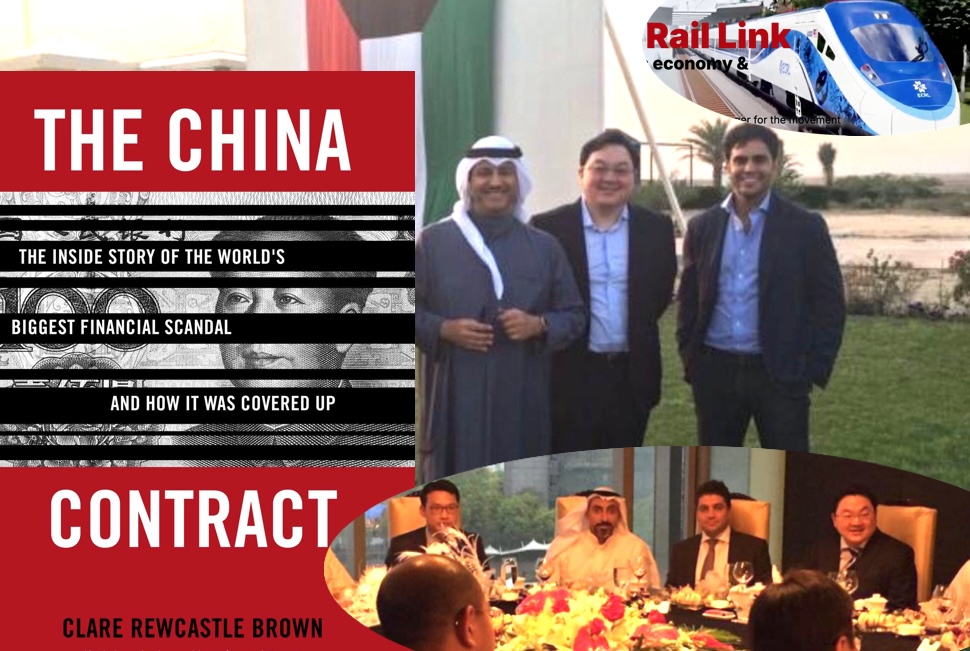
During the early months of 2016 the now fugitive 1MDB fraudster, Jho Low, made a number of trips to Kuwait on behalf of his ‘Big Boss’, Malaysian prime minister Najib Razak, with the avowed purpose of negotiating a new Chinese Belt & Road project in the Gulf State.
On these visits, which were facilitated by Najib, he was accompanied by Chinese diplomats and senior officials from the China’s Belt & Road initiative.
Sarawak Report later exposed the activity, thanks to evidence passed by the whistleblower Bachar Kiwan, along with its real purpose which, far from investing in Kuwait, was to funnel kickbacks stolen from a massively inflated Belt & Road rail project in Malaysia.
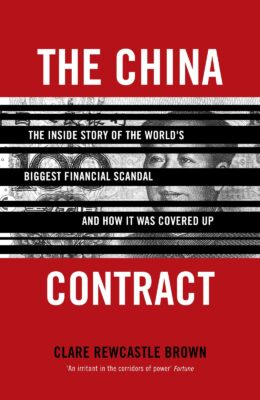
In a new book, The China Contract (published 12th November), this writer lays out the full story as a case study of Belt & Road corruption, involving China’s complicity at the highest official levels, in a plot that extracted billions through loans raised by Malaysia. In the process it sucked the country into the orbit of Belt & Road diplomacy and related debt dependency.
Although Jho Low was able to deploy senior Chinese officials to visit Kuwait and give expressions of intent to invest in an $8 billion ‘Silk Road’ development programme, the evidence indicates that project was a sham from the start, created as a facade to launder the equivalent sum of money that Jho and Najib planned to steal from East Coast Rail Link (ECRL) project that they were simultaneously negotiating to put in the hands of the Chinese contractors China Communications Construction Company (CCCC).
In the process Malaysia’s existing ECRL proposal would be converted into a genuine Belt & Road project as part of a treaty with China involving new economic and defence cooperation signed in November of that year.
Najib’s purpose was to bail out the Malaysian fund 1MDB, which had been looted by Jho Low and disguise its debt repayments, as a secret agreement passed to Sarawak Report in late July of that year would show.
That agreement laid out in detail how China’s officially designated contractor, CCCC, was to be granted a 100% price inflation of RM30 billion for the newly converted Belt & Road project in return for agreeing to return $7.5 billion dollars in backhanders to cover 1MDB debts and related payments to Jho Low. Chinese banks would be deployed to raise the money under a deferred repayment agreement which would be guaranteed by the Malaysian government.
The benefit to China was a compromised prime minister who would deliver a client country and, moreover, powerful control over a strategic transport link connecting the South China Sea to the Indian Ocean. Najib was selling his country’s independence to get off a hook of his own making.
Although the cover-up deal (which was immediately leaked by Sarawak Report) has been denied, and considerable confusion resulted after elements of the original contract fell through, new evidence and a close analysis of the money flows show how the commitments made in the original and blatantly corrupt ECRL Contract, hammered out by Jho Low with Chinese Communist Party officials in June/July 2016, were essentially followed through.
The money, as pre-planned, went to a network of companies in Kuwait ostensibly connected to the separate bogus Belt & Road project which never actually materialised. Chinese banks were used to facilitate each and every move in the inter-connected conspiracy and the use of Chinese currency by-passed US and European regulators who by 2016 had ‘Red Flagged’ Jho Low and 1MDB.
In a signature Jho Low manoeuvre, the son of the then Kuwait prime minister, Sheikh Sabah Jaber Mubarak al-Sabah (Sheikh Sabah), was the individual courted to front the Kuwaiti side of the operation. The fraudster would casually describe the sham Belt & Road initiative as being in partnership with The Kuwait Ruling family when it was convenient.
The same Chinese mega-contractor, CCCC, was also conveniently cited as the key sponsor thereby making it easier for backhanders from the contract in Malaysia to be passed under various business pretexts to CCCC’s alleged partners in Kuwait (who were in fact fronting for Jho Low).
There was just one major hitch in the process, according to our research, namely the block placed by the Penang state government of the sale of 1MDB’s Ayer Itam land plot. The action had been announced earlier in July amidst the growing concerns over fraud and it appears to have obstructed the plans for the first huge transfer of $850 million that CCCC had agreed to pay 1MDB on the excuse of purchasing the plot by mid-August.
That this transaction was timed in advance of even the first payment due on the contract was clearly symptomatic of 1MDB’s urgent need for cash and when this money did not eventuate on time it threw a massive spanner into the works for Jho Low and Najib who had been struggling to meet repayments due to Abu Dhabi’s IPIC fund, which had previously committed to shoulder 1MDB’s debts for a year under a term sheet signed in June 2015.
The duo needed to make it look as if 1MDB had its own resources to meet such payments (in fact the fund had been plundered of all its cash) and the plan had been to do so under the guise of the sale of the essentially worthless Ayer Itam asset, which had already been acquired at an inflated cost by 1MDB to allegedly conceal slush payments to the UMNO campaign in 2013.
CCCC had initially been willing to play ball on the sham purchase in clear anticipation of the promised project. The secret schedule leaked to Sarawak Report in July 2016 instructed the contractor to perform the $850 million transaction at arms’ length through a ‘CCCC nominated ‘credit worthy’ company A (unrelated to CCCC)’.
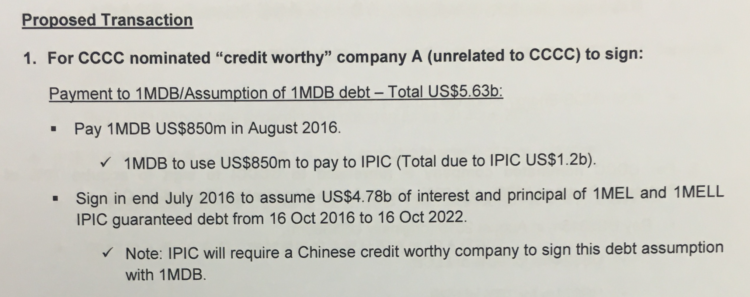
However, Penang’s freeze on the land title seems to have caused an early change of mind. The likely reason for CCCC’s decision to renege appears written in the ECRL contract itself which promotes the acquisition by CCCC as a genuine asset worth RM 1.3 billion.
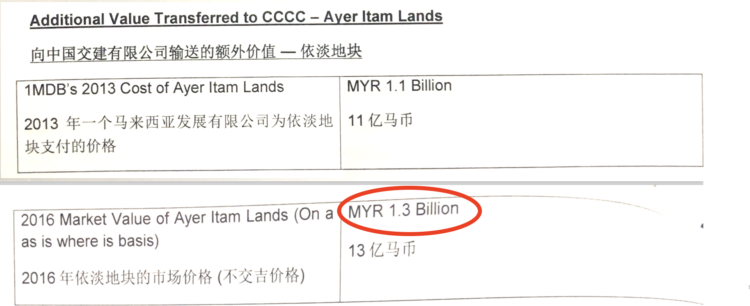
With the land title untransferable the camouflage was gone: not only was the deal worthless it could be proven to be worthless, leaving CCCC (or rather its ‘nominated company’) awkwardly exposed.
The reversal left the Malaysians with serious consequences. Following months of delay over the promised repayments IPIC first lodged a stock market alert in London and then humiliatingly sued 1MDB in early 2017.
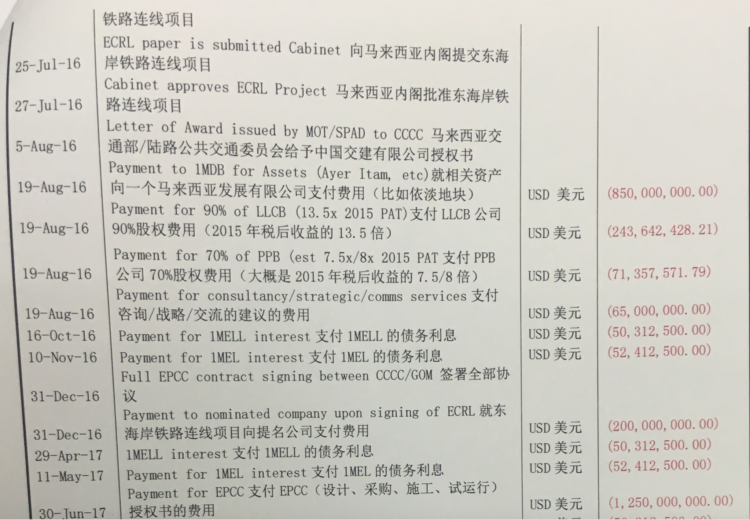
Yet, our research indicates that the other kickbacks listed in the schedule (which was dismissed as a fake story by ministers at the time) did largely take place on time, facilitated as planned by the money laundering network Jho Low had set up in Kuwait.
In 2020, having fled a campaign of persecution after he opposed the project, Bachar Kiwan, a business partner of Jho Low’s key collaborator in Kuwait, Sheikh Sabah, supplied Sarawak Report with information about those money flows. (Sheikh Sabah is presently serving a ten year jail sentence in Kuwait following his eventual conviction in the wake of our expose).
The documents provided by Bachar show the first evidence of money flowing to Kuwait from CCCC involving CNY450 million ($67.5m) that arrived in company he jointly owned with the Sheikh called Comoro Gulf Trading in September 2016.
This closely matches the agreed backhander from CCCC of $65 million due to be paid on August 19th (see schedule above), which was the same day the cancelled Ayer Itam purchase was meant to have taken place.
Although, like all the 1MDB backhanders listed in the ECRL contract, this payment was required to be made at arm’s length from CCCC, i.e. through a “CCCC nominated “credit worthy” company A (unrelated to CCCC)”, Sarawak Report easily identified the company that sent it, True Dragon Properties Ltd, to be a Hong Kong based subsidiary of the construction giant.
Indeed, True Dragon’s connection to CCCC was helpful in explaining Sheikh Sabah’s receipt of the enormous sum at the other end of the transaction in Kuwait, which was framed in the context of his alleged role as the local partner managing the purported Silk Road investment. It was a conflict that would expose China’s largest state-owned construction company’s duplicitous role once the Kuwaiti side of the deal was published.
Also due on August 19th were two further payments by CCCC to buy out substantial investments in two troubled Malaysian construction businesses, Putrajaya Perdana Bhd and Loh & Loh, which Jho Low had sought to offload over the years, including to the Tabung Haji fund which is now taking legal action to recoup its money.
These two purchases, apparently to get him off the hook, also appear to have fallen through for reasons one can only speculate: perhaps the emergence of Jho Low’s personal interest was a contention?
The next commitment in ECRL the contract did appear to be met, however, according to evidence that Sarawak Report was able to later obtain from a leaked investigation by Kuwait’s anti-money laundering officials prompted in 2018 by the post-Najib Malaysian government. This showed that a further CNY 1,299,999,987 ($195 million) was paid into another Sheikh Sabah company, Al Mouniratayn International General Trading in December 2016. [this was the sum finally confirmed in the Kuwaiti Court Judgement in 2023].
That sum closely matches the $200 million due to be paid as a backhander by CCCC the same month (see above contract) following the signing of the formal Belt & Road agreement by Najib in Beijing in November (this despite the prime minister having previously claimed Sarawak Report’s July document was fake).
This time the sender of the cash, Hong Kong based Yuen Kee Holdings, has been less easy to link directly to CCCC. However, the reasons given for the payment appear from the available documents to be linked to a completion of the same so-called bitumen contract cited in the first payments from CCCC’s subsidiary True Dragon.
A series of sometimes conflicting documents flew between Jho Low and his collaborators in Kuwait over this period to mask these transfers, following which Jho Low used a substantial amount of the money to cover his own pressing legal payments and a coupon due on 1MDB power purchase bonds.
The bitumen contract was bogus and no consignment was ever delivered. It was a cover story to explain these payments, which were all sent in Chinese Yuan to accounts specially set up in the newly established branch of ICBC Bank in Kuwait. Indeed, every aspect of the scheme was pre-meditated and actively and openly assisted by Chinese official support.
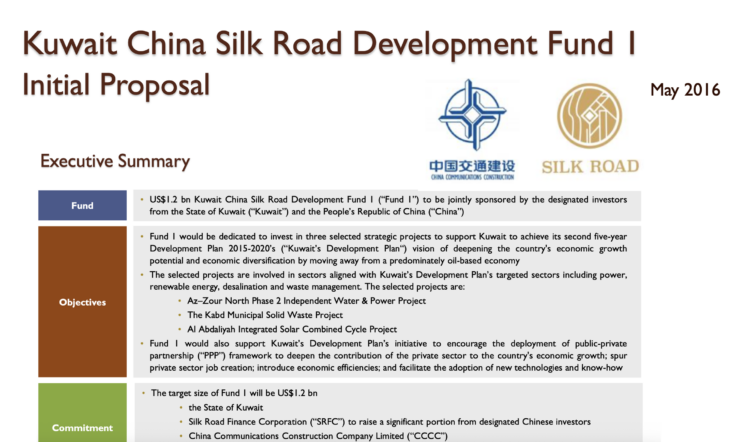
It is abundantly clear, therefore, that it was far from coincidental that Jho’s abortive Kuwaiti Belt & Road project was targeted in its proposal document at an $8 billion investment – approximately same sum as the $7.5 billion the ECRL secret schedule planned to suck out of the ECRL contract.
Equally un-coincidentally, that the first stage $1.2 billion investment (‘Fund 1’) of the sham Kuwait project matched the $1.25 billion scheduled to be the next major backhander from the ECRL project (see contract).

The backhander was due to be paid by June 2017 immediately after the projected arrival of the first tranche of the ECRL loan from China to CCCC at the start of the construction stage, according to the schedule (above).
As one financial analyst who has examined the money flows recently commented:
“An $8 billion fund in Kuwait with a $1.2 billion first phase looks, to me, like a container built to hold the $7.5 billion that was to come out of the rail contract and the $1.25 billion down-payment — money borrowed from China’s Exim bank on Malaysia’s guarantee’
China’s Exim Bank duly delivered on the down payment (CCCC received CNY17.320 bn/$2.5 bn, arriving April-June) and, at the end of August 2017, CNY7.279 billion ($1.02 bn) was paid into a newly incorporated company owned by Sheikh Sabah using a play on his name, Al Asbah.
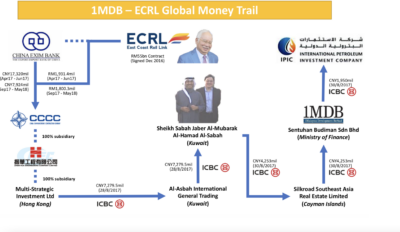
Whatever the original intention for this money, given the growing desperation of Najib’s situation with regard to paying 1MDB’ debt to IPIC that was where a chunk of the cash went within 48 hours of arriving in the Sheikh’s ICBC account in Kuwait.
According to a later Kuwait judgement the payment was justified to the bank in the context of the sham Belt & Road project validated by the official ceremonies involving Chinese officials (including the CEO of the Silk Road Finance Corporation, Dr Shan Li) the previous year. The judgement reads that it was stated to be ‘commission received … for a consultancy contract dated 22/7/2017 for the implementation of the Silk Road project…. falsely prepared for the company and, contrary to the truth, without any real work in return.’
Using ICBC bank accounts at every stage a substantial proportion of the cash, c$600 million in yuan, was forwarded by a shell company recently incorporated in the Seychelles under Sheikh Sabah’s ownership straight to the 1MDB subsidiary, Sentuhan Budiman Sdn Bhd, that owned Ayer Itam under the guise of finally buying that plot of land.
$600 million was the sum which had been agreed as a first payment to IPIC under a Consent Order that had put a stay to the legal action earlier in the year. In the event, not all that money was passed on to IPIC since matters had become so desperate by that stage, given all the delays in fulfilling those payments, that Najib had already been forced to dip into other government controlled entities, most particularly Khazanah, to raise some of the money owing – circa $300 million.
Therefore, on the day the payment arrived from Sheikh Sabah, Sentuhan Budiman sent the yuan equivalent of the remainder owing – CNY 1.950 billion – to IPIC using a ICBC bank account in Abu Dhabi.
All those transactions were conducted in yuan through China’s ICBC Bank using money loaned from Exim Bank under the Belt & Road scheme. Moreover, the shell company that allegedly bought Ayer Itam was tellingly named Silk Road Southeast Asia Real Estate Ltd (Seychelles) in a blatant attempt to link back to the alleged Belt & Road connection in order to justify the purchases back in Kuwait and provide a credible buyer for 1MDB.
Notably, this second purchase exercise, a year after the original attempt to sell the land to CCCC for $850 million, did not entail any attempt to offer value to the buyer. Whereas CCCC may have balked after discovering it could not obtain ownership of the land from the sham purchase, the matter clearly didn’t worry Sheikh Sabah who played the anonymous role of an off-shore buyer and had been handsomely rewarded in other ways. He did not attempt to acquire the title which was still frozen by the Penang government.
The broad details of the conspiracy as laid out in the original ECRL contract can therefore be seen as having been largely carried out to plan and to the sums agreed. As 1MDB struggled with its debts in the course of that first year, particularly with the collapse of the first Ayer Itam sale, so did some of the strategies and payments. This has created some confusion in the earlier accounts provided by officials investigating the matter after Najib’s removal from office.
For example, at the same time the ECRL contract was negotiated to bail out 1MDB, a second Belt & Road project involving two pipelines was signed to bail out the 1MDB subsidiary SRC, which had been used to borrow RM4 billion ($1 bn) from the KWAP civil service pension fund and was likewise struggling to repay it owing to further looting.
As has been reported, Najib, desperate for cash, organised for an extraordinary arrangement whereby 88% of the $2 billion loan from China to pay for the project was to be released up front to the construction company China Petroleum Pipeline Engineering (CPP).
The money came through in April 2017 much the same time as the first payment was release to CCCC. It was speculated the pipeline money could therefore have been the source of Sheikh Sabah’s payment for Ayer Itam. However, as Sarawak Report identified back in 2020, the payment to Al Asbar came from yet another CCCC subsidiary in Hong Kong named Multi-Strategic Resources Ltd. It also, as detailed, matched the commitment in the ECRL contract.
That established, it means that notwithstanding the later attempts by the PH government to retrieve some of the money (around $150 million) from CPP’s Malaysian bank accounts, a very large chunk of the loan for the pipelines has gone missing.
After all, it is a well-known scandal in Malaysia that virtually none of these pipeline projects were completed, despite the up front payment.
As Sarawak Report detailed earlier this year, settlement negotiations with China relating to these 1MDB/SRC related contracts appear to have been conducted in KL towards the end of 2025. The terms are reported to have involved a forgiveness of these loan debts by China in return for Malaysia keeping mum about the super-power’s engagement and collusion in Najib’s corruption.
This article is an update on an ever-moving story, told alongside the behind-the-scenes adventure about how it was exposed in:
THE CHINA CONTRACT
available digitally online and in selected bookshops
from November 12th